Managing diabetes requires more than checking a number once in a while. Understanding how glucose levels change throughout the day can help people and their healthcare teams make more informed decisions about treatment, food, physical activity, and daily routines.
For decades, blood glucose meters and finger-stick testing were the primary tools for monitoring blood sugar. Today, continuous glucose monitoring (CGM) systems offer a different approach, providing ongoing information about glucose levels and trends.
The technology has become an important part of diabetes care, but it is also evolving. From wearable sensors to connected insulin-delivery systems, new tools are changing how people monitor and manage their condition.
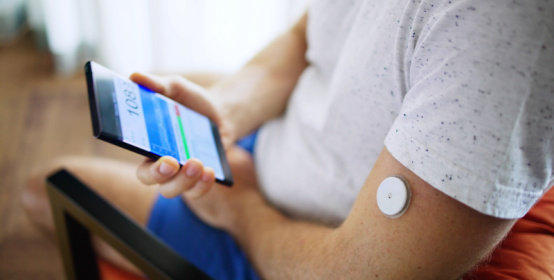
A continuous glucose monitor uses a small sensor placed just beneath the skin. Rather than measuring blood directly, the sensor measures glucose in the interstitial fluid, the fluid surrounding cells.
The sensor sends readings to a receiver, smartphone, or compatible device. Depending on the system, users can see their current glucose level, whether it is rising or falling, and how their levels have changed over time.
Many CGMs also provide alerts when glucose is approaching or entering a high or low range. These alerts can help users recognize changes they might otherwise miss, including overnight or between meals.
Unlike a traditional blood glucose meter, which provides a reading at a specific moment, a CGM creates a more continuous picture of glucose patterns.
Traditional blood glucose meters remain an important part of diabetes care. They measure glucose from a blood sample, usually obtained through a finger stick, and provide a reading at that moment.
CGMs offer a different kind of information:
The benefit is not simply fewer finger sticks. It is the ability to see how glucose changes over time and identify patterns that may be difficult to recognize from occasional readings.
The American Diabetes Association's 2026 Standards of Care recommend CGM for people using insulin and for certain others with diabetes, depending on their treatment, circumstances, and preferences. The choice of device should be individualized rather than based on the idea that one monitor is best for everyone.
One of the most useful features of modern glucose monitoring is the ability to see trends, not just individual readings.
For example, a person may notice that glucose rises after a particular meal, changes during exercise, or drops overnight. These patterns can provide useful information for discussions with a healthcare team.
CGM reports may also include a measurement called time in range, which describes how much time glucose levels remain within a selected target range. Other metrics can help identify periods of high or low glucose and changes in glucose variability.
These measurements do not replace medical advice, but they can give patients and clinicians a more complete picture of what is happening between appointments.
Wearable, Implantable, and Connected Systems
Most modern CGMs use a small wearable sensor attached to the skin. Some systems are designed for use over a period of days, while others use an implantable sensor that can remain in place for a longer period.
Implantable CGM technology is designed to reduce the need for frequent sensor replacement. For example, the FDA has approved the Eversense 365 system, which is designed to provide continuous glucose monitoring for up to one year in adults who meet its indicated use.
The technology continues to develop, but sensor lifespan is only one consideration. Accuracy, comfort, insertion method, alerts, app compatibility, cost, and access to supplies can all influence whether a particular system is appropriate for an individual.
Some of the most significant developments in diabetes technology involve connecting glucose monitoring with insulin-delivery systems.
In an automated insulin delivery system, a CGM provides glucose information to an insulin pump. The system can use that information to adjust insulin delivery according to its design and the user's settings.
These systems are sometimes described as “artificial pancreas” technology. They do not replicate every function of a healthy pancreas, but they can automate portions of insulin delivery and reduce some of the daily work involved in managing diabetes.
The FDA has approved several automated insulin delivery systems, and the technology continues to evolve.
It is important to distinguish between a glucose monitor and an insulin-delivery system. A CGM measures and reports glucose. An automated insulin delivery system combines glucose information with an insulin pump and control software to help manage insulin delivery.
The next generation of diabetes monitoring is moving beyond glucose alone.
In August 2026, the FDA authorized the Libre Duo 10 Day Continuous Dual Glucose Ketone Monitoring System, the first wearable device in the United States authorized to continuously monitor both glucose and ketone levels. Ketone monitoring can be particularly relevant when people with diabetes are at risk of diabetic ketoacidosis, a serious complication associated with elevated ketone levels.
Other areas of development include longer-lasting sensors, improved connectivity, better integration with insulin pumps, and systems designed to make glucose information easier to interpret.
The goal is not simply to collect more data. It is to make that information more useful and actionable.
For many people, CGMs offer advantages that traditional meters cannot provide, particularly when it comes to seeing glucose trends and receiving alerts.
However, traditional blood glucose meters remain important. The ADA recommends that people using CGMs also have access to blood glucose monitoring when appropriate. Certain situations may require a finger-stick reading or confirmation, depending on the device, symptoms, and clinical circumstances.
CGMs also require users to learn how to apply and maintain the sensor, understand alerts, interpret readings, and manage the associated technology. Cost and access can also affect whether a person can use a particular system consistently.
The most useful technology is not necessarily the newest. It is the technology that fits the person's treatment plan, needs, and ability to use it effectively.
Diabetes monitoring is becoming more connected, more continuous, and more personalized.
As sensors improve and become integrated with apps, insulin pumps, and other devices, people may have more opportunities to understand their glucose patterns and manage their condition with greater support.
At the same time, the fundamentals remain important: accurate measurements, reliable equipment, appropriate treatment, and guidance from qualified healthcare professionals.
The future of diabetes monitoring is not just about replacing the finger stick. It is about turning glucose data into information that can support better decisions - and making that information more accessible to the people who need it.