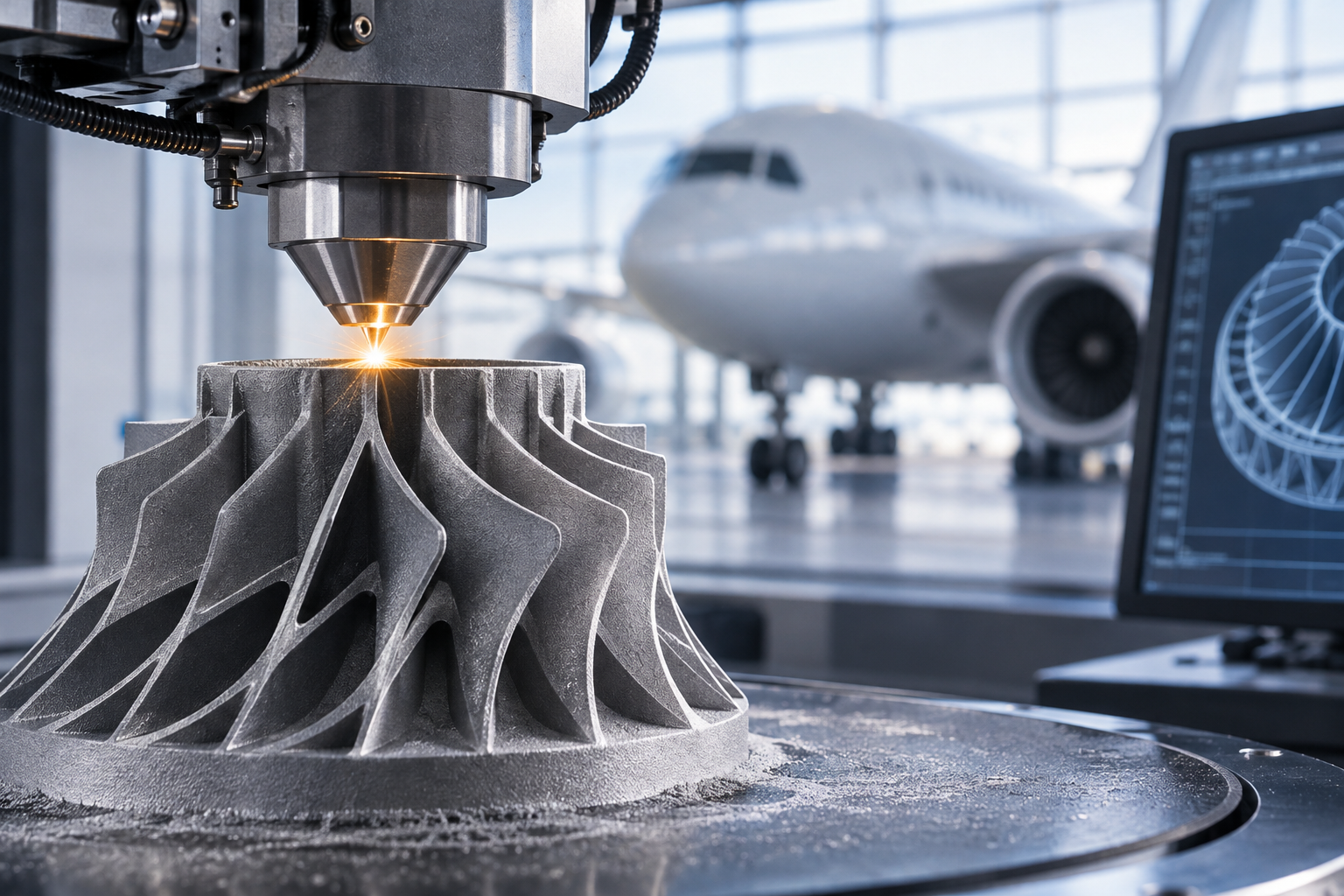
Aerospace manufacturing has always been driven by demanding requirements: reduce weight, improve performance, control costs, and produce components that can withstand extreme operating conditions. Today, additive manufacturing - commonly known as 3D printing - is helping engineers approach those challenges in new ways.
What began primarily as a rapid-prototyping tool has developed into a manufacturing technology used for tooling, production components, and specialized aerospace hardware. The technology is not replacing every traditional manufacturing process, but it is changing how certain parts are designed, produced, and maintained.
For aerospace manufacturers and suppliers, the opportunity is not simply to print a part. It is to determine where additive manufacturing can deliver a practical advantage while meeting the industry's demanding requirements for quality, reliability, and traceability.
Unlike conventional manufacturing, which often begins with a larger block of material and removes material through machining, additive manufacturing builds a component layer by layer from a digital design.
Depending on the process, the material may be metal powder, polymer, wire, or another specialized feedstock. Metal additive manufacturing methods, including powder bed fusion and directed energy deposition, are particularly relevant to aerospace applications because they can produce complex components from materials such as titanium, aluminum, and nickel-based alloys.
The process allows engineers to create geometries that may be difficult, expensive, or impossible to manufacture using traditional methods. However, the finished part still requires appropriate inspection, testing, and qualification for its intended application.
1. Reducing Weight Without Sacrificing Function
Weight is a critical consideration in aircraft and spacecraft. Reducing the weight of a component can contribute to lower fuel consumption, increased payload capacity, or improved overall performance.
Additive manufacturing gives engineers greater freedom to create lightweight structures, internal channels, and optimized geometries. Instead of designing a part around the limitations of a machining tool, engineers can design around the loads, performance requirements, and material needed for the application.
The result may be a component that uses less material while still meeting its functional requirements.
2. Consolidating Multiple Parts Into One
Traditional assemblies sometimes require several components, fasteners, and joining operations to create a single functional unit. Additive manufacturing can make it possible to combine certain components into one printed part.
Part consolidation can reduce the number of joints, simplify assembly, and potentially reduce opportunities for leakage, failure, or maintenance. It can also reduce the amount of inventory needed for an assembly.
This does not mean every multi-part assembly should become one printed component. Engineers must still evaluate strength, inspection access, maintenance requirements, and the practical benefits of consolidation.
3. Creating More Complex Designs
One of additive manufacturing's most important advantages is design freedom.
Internal passages, lattice structures, curved channels, and other complex geometries can be produced without requiring the same tooling or machining access as traditional manufacturing. This opens possibilities for components designed to improve cooling, reduce weight, manage airflow, or optimize material placement.
NASA has been developing additive manufacturing technologies for spaceflight hardware, including rocket-engine components and advanced alloys. Its RAMPT project, for example, has used additive manufacturing to produce a rocket engine combustion chamber and nozzle from NASA-developed alloys.
4. Shortening Development and Production Lead Times
Aerospace components often require specialized tooling, fixtures, or molds. For prototypes and low-volume production, those requirements can add time and expense before a part is even manufactured.
3D printing can reduce the need for certain forms of dedicated tooling and allow manufacturers to move more quickly from a digital design to a physical prototype. Engineers can test a design, identify changes, and produce a revised version without necessarily creating an entirely new set of traditional tooling.
The benefits are particularly relevant when a manufacturer needs a small quantity of specialized parts rather than thousands of identical components.
5. Improving Tooling and Production Support
Not every aerospace 3D-printed part goes into an aircraft or spacecraft.
Additive manufacturing is also used to produce jigs, fixtures, gauges, assembly aids, and other production tools. These items can be customized for a particular operation and, in some cases, produced more quickly or economically than traditionally manufactured alternatives.
For manufacturers, this can improve production flexibility without requiring every tool to be treated as a flight-critical component.
6. Supporting Maintenance and Replacement Parts
Aerospace maintenance, repair, and overhaul operations often involve parts that are difficult to source, have long lead times, or are no longer produced in large quantities.
Additive manufacturing may offer a way to produce certain replacement or repair components, particularly when the original design is available digitally and the material and manufacturing process can be properly qualified.
However, a digital file alone does not make a part approved for aircraft use. The component must meet the applicable design, manufacturing, inspection, and airworthiness requirements.
The Aerospace Industries Association's 2025 guidance specifically addresses the use of additive manufacturing in maintenance, repair, and overhaul, reflecting the industry's growing attention to these applications.
Aerospace applications place demanding requirements on materials. Components may need to withstand high temperatures, vibration, pressure, corrosion, or repeated mechanical loads.
Commonly discussed materials include:
The material is only part of the equation. The manufacturing process, build parameters, heat treatment, surface finishing, and inspection methods can all affect the final component's properties.
That is why aerospace additive manufacturing requires a controlled process - not simply a capable printer.
Aerospace is not an industry where a part can be approved simply because it looks correct or performs well in an initial test.
Manufacturers must demonstrate that the component meets the requirements of its intended application. This can involve material characterization, process qualification, dimensional inspection, nondestructive testing, mechanical testing, and documentation of the manufacturing process.
The FAA has published Advisory Circular 33.15-3, which describes an acceptable means of demonstrating compliance for aircraft engine parts produced using powder bed fusion additive manufacturing. The guidance addresses the manufacturing process and related design and material considerations.
The FAA also emphasizes that approval of a material or manufacturing process does not automatically authorize installation of a part in every aircraft. The component must still meet the applicable airworthiness requirements for the specific aircraft or application.
This distinction is important: additive manufacturing creates new possibilities, but aerospace certification determines which possibilities can be used in flight.
Despite its advantages, additive manufacturing is not the right solution for every aerospace component.
Challenges can include:
The most effective approach is to evaluate additive manufacturing alongside traditional methods rather than assuming one technology should replace the other.
As additive manufacturing becomes more established, aerospace suppliers will increasingly need to understand how printed components fit into larger manufacturing and assembly systems.
That includes more than the printing process itself. It also involves material compatibility, dimensional requirements, joining methods, inspection, hardware selection, and the documentation needed to support quality and traceability.
For suppliers of fasteners and electronic hardware, the continued evolution of aerospace manufacturing reinforces the importance of providing components that meet precise specifications and perform reliably in demanding environments.
Whether a component is machined, cast, forged, or additively manufactured, the surrounding hardware and assembly requirements remain critical to the finished product.
Additive manufacturing is already contributing to aerospace development and production, but its long-term impact will depend on continued advances in materials, process control, design software, inspection, and certification.
The most meaningful progress may not come from printing an entire aircraft or spacecraft. It may come from producing a lighter component, consolidating an assembly, reducing tooling requirements, or making a specialized replacement part more practical to manufacture.
For aerospace manufacturers, the question is becoming less about whether 3D printing is possible and more about where it creates measurable value - and how to integrate it into a reliable, qualified manufacturing process.
As those capabilities continue to develop, additive manufacturing will remain an important part of the aerospace industry's broader move toward more flexible, efficient, and digitally driven production.