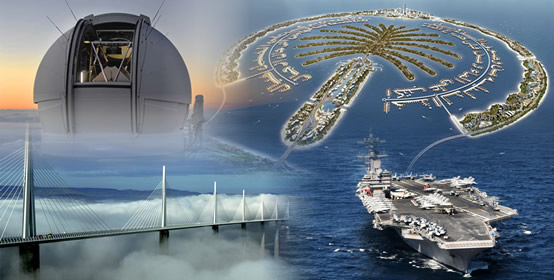
Technology has turned once-impossible ideas into reality. Engineers today routinely tackle problems that seemed unsolvable just decades ago, using cutting-edge tools, materials, and designs. Towering skyscrapers, delicate yet powerful cable bridges, and entire artificial landscapes have all become part of our world. The achievements below only scratch the surface of engineering feats from the last 20-plus years, ranging from bridges and stadiums to a telescope, a man-made archipelago, and even the world beyond Earth's atmosphere.
This cable-stayed bridge was built to span the Tarn Valley and ease traffic along the A75 motorway between Paris, France, and Béziers, Spain. It has won numerous awards for its structure and architectural style. The design was selected as the winning entry in a 1996 competition and underwent extensive testing for wind shear and load requirements. Construction began in 2001 and wrapped up in December 2004. The Millau Viaduct remains the tallest bridge in the world.
Built to measure tiny particles and their properties, the Large Hadron Collider is the world's largest particle collider. It has helped scientists explore new theories about the origins of the universe and the fundamental workings of matter. Constructed between 1998 and 2008, the project brought together more than 10,000 scientists from around the globe.
Nicknamed the “Bird's Nest” for its resemblance to one, Beijing's National Stadium combines environmentally friendly materials with native steel girders. Its interwoven lattice design gives the structure remarkable strength despite its open, porous appearance. The final build differed significantly from the original 2003 plans, with numerous revisions made to boost durability and structural integrity. It opened just in time for the 2008 Olympics.
These palm-shaped islands off the coast of the United Arab Emirates are part of a larger effort to expand Dubai's coastline. Built from dredged sand and blasted rock, the islands form a crescent-shaped breakwater protected by erosion-resistant geotextile materials. Palm Jumeirah was among the first of these artificial islands, with construction beginning in 2001.
Laid down in 2003 and commissioned in 2009, the USS George H.W. Bush is the tenth and final Nimitz-class supercarrier built for the US Navy. Its engineering advances include major environmental and operational upgrades, such as automated refueling systems for aircraft on the flight deck — a significant leap over earlier carrier classes.
Billed as the world's tallest outdoor elevator, the Bailong Elevator rises roughly 1,070 feet (326 meters) along a sandstone cliff in Zhangjiajie National Forest Park. Construction ran from 1999 to 2002, with safety and structural concerns extending the timeline. It's also known as the “Hundred Dragons” elevator.
This telescope and rapid-response survey system scans the sky from multiple angles to build a panoramic view of the heavens, with a key focus on tracking objects that could pose a threat to Earth. The first Panoramic Survey Telescope and Rapid Response System came online in 2008. The combination of telescopes, advanced cameras, and a dedicated computing facility makes it an engineering marvel in its own right.
First conceived in 1997, this pipeline was designed to carry natural gas from Vyborg, Russia, to Greifswald, Germany, across roughly 759 miles of seabed. A feasibility study followed in 2001, with environmental assessments and partnerships taking shape between 2005 and 2010. The first line was inaugurated on November 8, 2011.
Standing 2,717 feet (828 meters) tall, the Burj Khalifa is the world's tallest building and a landmark of structural innovation. Its engineers developed a “buttressed core” system: a hexagonal central core supported by three wings arranged in a Y-shaped floor plan, which both reduces wind loads and allows for efficient, repeatable construction as the tower rises. The exterior is finished with aluminum and stainless-steel panels, vertical tubular fins, and more than 28,000 hand-cut glass panels. Construction began in 2004, and the tower officially opened in January 2010.
Spanning the Yangtze River, the Three Gorges Dam is the largest hydroelectric power station in the world by capacity. The straight-crested concrete gravity structure stretches 2,335 metres (7,660 feet) long with a maximum height of 185 metres (607 feet), incorporating 28 million cubic metres of concrete and 463,000 metric tons of steel. Construction began in 1994, the dam structure was completed in 2006, and the plant reached full generating capacity in 2012. Beyond power generation, the project enables oceangoing freighters to navigate hundreds of miles upstream — a feat of engineering on a scale rarely attempted.
Connecting the city of Kobe to Awaji Island, the Akashi Kaikyō Bridge holds the record for the longest central span of any suspension bridge in the world, at nearly 2 kilometers. Completed in 1998 after roughly a decade of construction, the bridge was engineered to withstand both powerful typhoons and major earthquakes — a necessity given its location near a seismically active fault line. Its towers and cables were designed with enough flexibility to absorb these forces without compromising the structure.
Assembly of the ISS began in 1998, piecing together modules launched from multiple countries into a single orbiting laboratory roughly the size of a football field. As one of the largest cooperative engineering projects ever undertaken, it required astronauts and robotic systems to connect components in orbit with extreme precision, creating a permanently crewed research platform that has operated continuously for more than two decades.
For decades, rockets were single-use, with each launch discarding millions of dollars of hardware. That changed on December 22, 2015, when SpaceX achieved the first successful controlled landing of an orbital-class rocket's first stage. Since then, Falcon 9 boosters have landed and flown again nearly 650 times, fundamentally reshaping the economics of spaceflight and paving the way for more ambitious missions beyond Earth orbit.
The vast array of engineering achievements in the past twenty years shows human ingenuity and the promise of more wonders to behold.