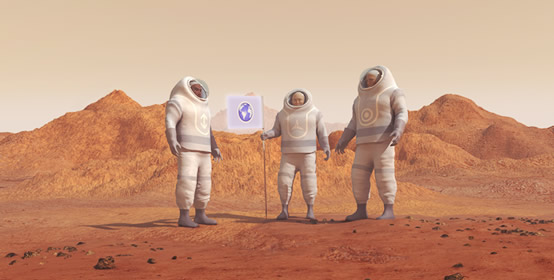
Interest in sending humans to Mars has never been higher. Governments, private launch providers, and investors now discuss permanent settlements rather than brief visits. Yet as plans become more detailed, it is increasingly clear that Mars is not simply a longer Apollo mission but a fundamentally different engineering challenge. The problem is no longer reaching space. It is operating reliably far from Earth for years at a time.
Recent developments surrounding SpaceX’s Starship program and NASA’s Artemis architecture have transformed Mars exploration from distant aspiration into active planning. At the same time, revised schedules and shifting priorities reveal how many obstacles still stand between Earth and a human landing.
Mars exploration has always been shaped by optimism. Earlier projections suggested uncrewed missions as soon as 2026 followed by human flights only a few years later. Those plans depended heavily on proving orbital refueling dependency, the ability to launch multiple spacecraft and transfer fuel between them in space. Without this capability, a Mars spacecraft cannot carry enough propellant to leave Earth and arrive safely at its destination.
As testing progressed, expectations shifted. SpaceX acknowledged a low-probability Mars launch in the near term because the fuel transfer systems required for deep space travel remain unproven at operational scale. Instead of pushing directly toward Mars, development efforts turned toward the Moon as an intermediate proving ground, reflecting how the industry has prioritized the Moon before Mars.
The shift mirrors a familiar pattern in aerospace history. Ambitious milestones rarely disappear, but timelines expand as technical complexity becomes better understood.
A journey to Mars depends on planetary alignment that occurs roughly every two years, creating a narrow 26-month launch window. Each mission would then require about six months of travel. A failed attempt could delay progress for years.
By comparison, the Moon allows rapid testing cycles and constant iteration, demonstrating the rapid lunar iteration advantage. Engineers can study long-duration hardware, life-support systems, and autonomous operations repeatedly without waiting years between attempts. The lunar surface effectively becomes a nearby laboratory for the technologies required for Mars habitation.
Reaching Mars requires more than a powerful rocket. It requires a transportation network operating at a frequency never before attempted in spaceflight. Current mission concepts depend on a multiple launch requirement, where many launches assemble and fuel a spacecraft in orbit before departure.
This introduces new engineering risks. Cryogenic propellants must remain stable in orbit and transfer between spacecraft without significant loss, creating major cryogenic fuel transfer challenges. Reusable spacecraft must also survive extreme heat and stress repeatedly, and ongoing testing continues to raise Starship readiness concerns. Even if those issues are solved, the program depends on a sustained industrial launch cadence requirement resembling commercial aviation rather than traditional space missions.
The journey itself presents hazards beyond transportation. Astronauts traveling for months outside Earth’s magnetic protection would encounter continuous radiation exposure. Shielding solutions must protect crews without making spacecraft too heavy to launch.
Hardware must also operate continuously for years under vacuum and extreme temperature changes, introducing significant long-duration reliability constraints. Communications delays approaching twenty minutes prevent real-time troubleshooting from Earth, forcing onboard systems to detect and correct failures independently. The mission therefore, becomes a reliability challenge as much as a propulsion challenge.
Mars exploration today is shaped not only by science but also by infrastructure strategy and economics. Governments emphasize lunar development as a stepping stone, reflecting a policy emphasis on Moon infrastructure. Meanwhile, private companies depend on commercial revenue streams, demonstrating commercial funding dependence. In practical terms, Mars requires an ecosystem before it requires a landing.
Mars exploration has shifted from a single historic milestone to a sustained industrial effort. The remaining barriers include manufacturing scale, materials endurance, automation, and long-term operational reliability. The challenge is no longer whether humans can reach Mars once, but whether they can do so repeatedly and safely.
The path to the Red Planet will be measured not by one launch, but by the development of dependable systems capable of operating far beyond Earth. Until those systems exist, the greatest obstacle to Mars is not distance but reliability.