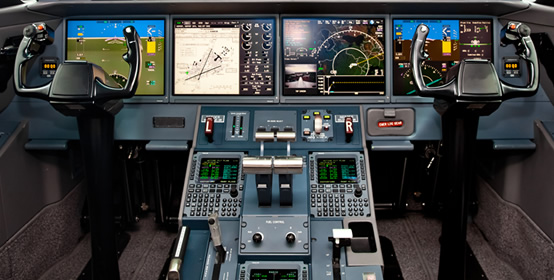
Artificial intelligence has been around for decades, but recent advances have pushed aviation technology closer to a reality that once seemed like pure science fiction. The idea of planes flying themselves evokes images of futuristic worlds, from The Jetsons to sleek air taxis buzzing above city skylines. Incredibly, researchers and manufacturers have been testing technologies that make fully autonomous flight more plausible than ever.
At this stage, the challenge is less about whether the technology can work and more about whether passengers, regulators, and the public are ready to trust it. Understanding today’s automated flight systems, the latest self-flying prototypes, and the emerging visions for autonomous aviation provides a clearer picture of where this field is heading.
Autopilot has been part of aviation for many decades. In 1947, a U.S. Air Force aircraft completed a transatlantic flight using an electronic autopilot, a landmark demonstration of “push-button flying” that showed how far automation could go in controlled conditions. Work on fully automated landings progressed through the postwar period, with the Royal Aircraft Establishment’s research laying foundations for all-weather landing techniques that evolved into modern autoland systems, described by the Royal Aeronautical Society. Today’s certification catalogs for Category II and Category III operations show where autoland is approved and under what conditions, outlined by the FAA.
Modern commercial aircraft rely heavily on this family of systems. Stephen Rice of Embry-Riddle explains that airline pilots typically hand-fly only three to six minutes of a routine flight, with automation managing most of the remaining workload. Autopilot can assist with climb, cruise, descent, and approach, while pilots remain essential for oversight and decision-making, especially in abnormal conditions. Fully automated takeoff and landing exist on some certified aircraft and runways but remain tightly regulated, as noted in SKYbrary’s autoland overview. Ground taxiing is still largely manual, although manufacturers and airports continue to experiment with taxi assistance and surface-movement automation.
Self-flying planes are often compared to self-driving cars, but the environments they navigate are very different.
Cars must contend with crowded roads, unpredictable traffic, pedestrians, and obstacles that appear without warning. Even with designated lanes, the variability is immense. Airplanes, however, operate in a controlled environment. Air traffic controllers assign flight paths, speeds, altitudes, and headings, which reduces the unpredictability that cars face.
That structure gives aviation an advantage when it comes to autonomy. Yet the stakes are also higher. An error in a car might cause a fender bender. An error in an aircraft could have catastrophic results. That is why aviation regulators demand multiple layers of redundancy and safety validation before approving new systems.
Several companies are developing prototypes and pilot programs that demonstrate what self-flying technology could look like in practice.
Boeing has experimented with autonomous passenger aircraft concepts, using artificial intelligence to reduce pilot workload and potentially enable single-pilot or pilotless operations.
Airbus tested its Vahana project, an electric vertical takeoff and landing (eVTOL) aircraft designed for short urban trips. While the program has since concluded, Airbus continues to advance autonomy under its broader Urban Air Mobility portfolio.
Embraer’s Eve Air Mobility has become one of the leading players in the urban air taxi race. In July 2024, Eve rolled out a full-scale flying taxi prototype in Brazil. The eVTOL is expected to enter service by 2026, with ongoing tests focused on transitioning between vertical and horizontal flight.
Hyundai’s Supernal division introduced the S-A2 eVTOL at CES 2024, aiming for commercial certification by 2028. While the first models will include human pilots, Hyundai has stated that pilotless operations could be possible in the future if technology and regulations allow. This milestone was covered in Le Monde’s report on Hyundai’s flying taxi plans.
Volocopter, a German startup, has already carried out numerous public demonstration flights with its fully electric air taxis. The company is preparing for commercial launches, with Paris expected to be one of the first cities to host its services.
Civilian adoption of autonomous aircraft may be slow, but military programs are moving quickly.
In October 2024, DARPA awarded Sikorsky a contract to expand the autonomous capabilities of the UH-60M Black Hawk helicopter. Using its MATRIX system, Sikorsky has already demonstrated fully pilotless flights, and new tests are expected in 2025. This effort aims to support missions in dangerous environments without risking crew lives, according to DefenseScoop’s coverage of the DARPA program.
These projects highlight how autonomy can improve safety and expand mission profiles. History shows that once technologies prove themselves in military settings, they often make their way into commercial use. GPS is one of the clearest examples.
Perhaps the most visible progress in self-flying aviation comes from urban air mobility. These electric VTOL aircraft, sometimes called flying taxis, are designed to transport passengers quickly across crowded cities.
Dubai has long promoted itself as a test bed for futuristic transport, and city officials have supported pilot projects for aerial taxis. Paris is preparing to showcase air taxi flights during major events, while Los Angeles and Seoul are building regulatory frameworks for commercial launches.
Companies like Joby Aviation, Archer, Lilium, and Volocopter are at the forefront of this movement. Most plan to start with piloted services but design their aircraft with autonomy in mind so they can transition once regulators and the public are ready.
Technology may be advancing, but public trust is harder to win. Surveys consistently show hesitation about boarding a pilotless aircraft.
A study conducted in the U.S. with nearly 1,000 participants measured willingness to use Advanced Air Mobility vehicles. The results showed mixed attitudes, with safety concerns and regulatory oversight cited as top barriers. Younger respondents and those more familiar with technology were more open to trying it. These results suggest that acceptance will grow gradually. Just as passengers once hesitated to trust elevators without operators or cars with adaptive cruise control, people may eventually view autonomous flight as normal once exposure and reliability improve.
If self-flying planes become widely accepted, the benefits could be significant:
These advantages explain why investment continues to pour into autonomous aviation despite skepticism.
Still, several obstacles stand in the way of fully autonomous passenger flights:
Each of these challenges is solvable, but none can be ignored.
Forecasts suggest that advanced air mobility could become a multi-billion-dollar industry within the next decade. Embraer projects its Eve subsidiary will be a major revenue driver by 2030. Hyundai has pledged billions to develop its Supernal aircraft, while governments in the U.S., Europe, and Asia are funding urban air mobility infrastructure.
According to Reuters reporting on Eve’s prototype rollout, the company has already secured hundreds of pre-orders for its eVTOL aircraft, signaling strong commercial interest.
By the late 2020s, pilot-operated air taxis may be operating in several global cities. Fully autonomous commercial flights, however, are likely to take longer, with experts pointing to the 2030s for widespread adoption.
The idea of stepping onto a plane with no pilot at the controls may still feel unsettling, but it is no longer science fiction. From Embraer’s prototypes to DARPA’s autonomous Black Hawk, the foundation for autonomy in aviation is already here.
Public trust remains the biggest hurdle. Yet as air taxis debut, as military programs prove reliability, and as artificial intelligence continues to permeate everyday life, the notion of autonomous aircraft will start to feel less daunting.
For now, pilots remain an essential presence in the cockpit. But the trajectory is clear: aviation is steadily moving toward a future where the pilot’s role is optional, not mandatory. Within the next decade or two, boarding a self-flying aircraft may feel just as normal as relying on autopilot does today.