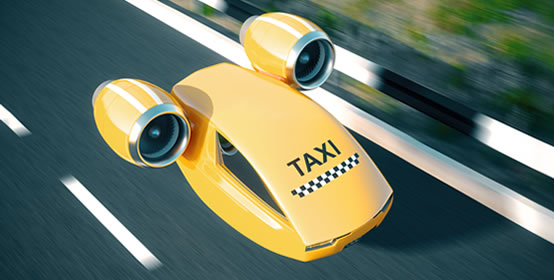
In recent years, owning a car is often more burden than convenience, especially in densely populated cities. Aside from the climbing costs of parking fees, roads remain congested for hours every day. And while some cities have a well-developed transit system, there is still a struggle to keep pace with rapid urban growth.
In response, flying taxis were presented as a futuristic solution, promising short trips across rooftops instead of gridlocked streets. Today, that idea has begun moving from demonstration to early deployment, though not without limitations.
The concept is simple. Small aircraft lift vertically like helicopters, cruise above traffic, and land on compact pads integrated into urban infrastructure. The reality is more complex, involving electrification, automation, certification, and entirely new transportation networks operating above cities.
The practicality of flying taxis depends largely on a shift away from conventional aviation. Traditional aircraft require extensive maintenance, trained crews, and large volumes of fuel. Modern air taxi designs instead rely on electric vertical takeoff and landing aircraft, commonly called eVTOLs. These vehicles use multiple small rotors powered by batteries rather than jet fuel, reducing noise and emissions while simplifying mechanical systems.
Prototypes have evolved into production candidates, and soon, flying taxis are set to launch in multiple regions. Several governments and operators now plan to introduce commercial routes in the near term, with some regions expecting regular service in 2026. Cities such as Dubai are also preparing infrastructure and operational frameworks for initial deployment.
These aircraft are not intended to replace airplanes. Instead, they operate as short-distance connectors between airports, business districts, and transit hubs. Their purpose is to reduce travel time across dense urban corridors rather than provide long-range transport.
Early flying taxi visions depended heavily on autonomy, imagining vehicles operating without onboard pilots. In practice, the industry has taken a gradual approach. Initial services are expected to include trained operators while automated flight systems mature and regulators build confidence in reliability.
Aircraft already benefit from structured airspace, predictable flight paths, and centralized control systems, allowing automation to advance faster than ground vehicles in certain scenarios. Still, full autonomy remains a long-term goal rather than an immediate feature. Current plans emphasize supervised operations with increasing automation over time, balancing technological capability with passenger acceptance and certification standards.
The economic model resembles ride sharing more than traditional aviation. Instead of chartering an entire helicopter, passengers book individual seats on short routes. Several companies are preparing scheduled services for these passenger air taxis between major urban destinations.
Industry analysts expect the first operational networks to function as premium transportation before expanding to broader use. Much like early ride-sharing platforms, adoption will likely begin with business travelers and airport transfers before scaling toward wider affordability.
Technology is no longer the only barrier. Certification remains one of the largest challenges facing the industry. Aviation safety standards require aircraft to demonstrate extremely high reliability before carrying passengers, and electric multirotor designs do not fit neatly into existing regulatory categories.
Authorities must define air traffic management, pilot requirements, maintenance protocols, landing infrastructure, and emergency procedures. Each step demands years of testing and documentation. Even after approval, cities must integrate vertiports, charging systems, and routing corridors into already crowded urban environments.
For this reason, early deployments are expected to be limited in geography and scale. Initial routes will operate in carefully controlled corridors rather than open citywide networks.
Flying taxis now occupy a space between science fiction and public transit. They are no longer speculative prototypes, but neither are they ready to replace cars or trains. Instead, they represent the beginning of a new transportation layer positioned between aviation and ground mobility.
The coming years will determine whether they remain a premium convenience or evolve into a widespread commuting option. Infrastructure, regulation, and cost will shape that outcome as much as engineering.
Urban congestion created the demand for aerial mobility. Whether flying taxis become a daily commute or a specialized service, their transition from concept to limited reality marks a significant shift in how cities may eventually move people above the streets rather than through them.