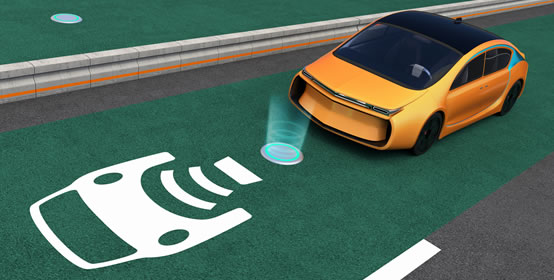
Vehicles of the future will most likely be electric, wirelessly charged, and increasingly automated. In recent years, wireless charging has moved from theoretical research into commercial pilots and real-world test beds. Engineers have already demonstrated that electric vehicles (EVs) can charge while parked, and in some cases, even while driving. With major automakers, startups, and government agencies investing in the space, wireless power transfer for EVs is no longer just a futuristic idea. It is becoming an integral part of the transportation systems of tomorrow.
Wireless power transfer (WPT) is the transmission of electrical energy from a source to a load without physical connectors or conductors. For electric vehicles, this typically means using electromagnetic fields to deliver power between a charging pad on the ground and a receiver coil installed in the underside of the car.
Until recently, this approach was mostly limited to static charging, where the car must be precisely parked over the pad for charging to occur. Efficiency was also highly sensitive to coil alignment, gap distance, and frequency tuning.
That changed when researchers at Stanford developed a self-tuning wireless circuit that can automatically adjust to a moving receiver. Their innovation removed the need for constant manual tuning, allowing power delivery to remain stable even as the EV moves across a charging surface. This was a foundational leap toward dynamic wireless charging.
Most EV wireless charging systems use one of two core technologies: inductive coupling or magnetic resonance.
Inductive charging uses tightly coupled coils in close proximity. The closer and better aligned the coils are, the higher the efficiency. This approach is well suited to static environments such as residential garages, parking lots, or taxi depots.
Resonant charging enables more flexibility in coil alignment and distance. By tuning both the transmitter and receiver to the same resonant frequency, power can be transferred over a greater range with less sensitivity to positioning. This principle is central to dynamic wireless charging systems being tested for highway applications.
A 2024 review of compensation topologies and inverter strategies confirmed that wide-bandgap semiconductors like gallium nitride (GaN) are pushing efficiency and scalability even further. These advances enable safe and fast wireless power transfer even at high voltages and speeds.
Dynamic charging, the ability to charge a vehicle while it is in motion, is one of the most exciting frontiers in wireless EV technology.
In France, Qualcomm demonstrated a dynamic wireless charging track capable of delivering up to 20 kW to multiple vehicles driving at highway speeds. Cars were able to enter and exit the charging zone seamlessly, proving that real-time coil switching and alignment could be handled on the fly.
Meanwhile, researchers in South Korea have been running electric buses on a wirelessly charged route in Gumi City since 2013, as part of the Online Electric Vehicle (OLEV) project. The buses receive power from coils embedded beneath the roadway, eliminating the need for charging stops during the day.
In the United States, Michigan has launched its first public wireless charging roadway in Detroit. Built by Electreon, the system will support dynamic wireless charging for properly equipped vehicles. The pilot will test long-term durability, public adoption, and integration with smart mobility systems.
Several automakers and suppliers are racing to commercialize wireless charging systems.
Porsche will debut its 11 kW wireless charging pad with the 2026 Cayenne Electric. The system, installed in the home garage, allows for seamless inductive charging by simply parking over the plate. According to Porsche’s official announcement, the pad uses precise vehicle alignment technology to maintain efficiency without driver input.
BMW previously tested wireless charging for its 530e plug-in hybrid in the United States and Germany. The pilot program collected data on user behavior, system reliability, and installation logistics, laying the groundwork for future production systems.
WiTricity, a spin-off from MIT, continues to supply wireless charging hardware and intellectual property to global automakers. The company’s licensed technology has already been integrated into pilot vehicles in Asia, North America, and Europe.
HEVO, a New York–based startup, is advancing wireless EV charging through industry collaborations. In 2023, the company announced a partnership with Stellantis to integrate wireless charging into future EV models. More recently, it unveiled a wireless autonomous charging depot solution with STEER Tech, aimed at enabling fleet vehicles to charge without human intervention.
Wireless charging offers more than just convenience. It enables a range of use cases that are difficult or impossible with plug-in systems:
SAE International reports that in-road wireless charging could extend EV range without requiring vehicles to stop. A recent academic review on charge-on-the-move solutions also notes that in certain duty cycles, such as high-frequency bus routes or logistics fleets, dynamic charging could allow for smaller battery packs while maintaining performance.
Despite its promise, wireless EV charging still faces several challenges:
Still, as manufacturers integrate wireless receivers into new models and infrastructure scales up, many of these challenges are expected to diminish.
The wireless EV charging market is growing rapidly. A recent report from Allied Market Research estimates that the global market was USD 466 million in 2023 and will reach USD 12.4 billion by 2033, growing at a compound annual growth rate of nearly 39 percent.
Early adoption is expected to be strongest in urban centers, transport depots, and high-end residential applications. Government incentives and sustainability mandates will likely accelerate investment in wireless-ready infrastructure.
What was once a speculative concept is now a real part of the global EV roadmap. From Porsche’s home charging pad to Michigan’s electrified street, wireless power transfer is emerging as both a convenience and a strategic solution for scalable EV adoption.
Whether enabling autonomous vehicles to charge themselves or letting buses stay on the road without downtime, wireless EV charging is no longer confined to lab experiments. It is rolling out city by city, model by model, powered by rapid technical innovation and growing public support.
As technology matures and infrastructure expands, the future of charging could look very different: silent, seamless, and cable-free.