Virtual reality has been hyped for years, but it is augmented reality (AR) that is making the biggest impact in manufacturing today. In 2025, AR is no longer just about entertainment or gaming. It has matured into a practical tool that factories use every day to reduce errors, train workers, and keep production moving.
Manufacturers face more pressure than ever before. They are dealing with rising costs, supply chain disruptions, labor shortages, and increasing customer demands. At the same time, they must deliver products faster and at higher quality. AR is stepping in as one of the most effective solutions, giving workers the ability to access real-time data and instructions right where they need them — on the production floor.
Unlike virtual reality, which takes users into a separate digital world, AR blends the digital with the physical. This makes it perfectly suited for manufacturing, where people still work with machines, tools, and physical products but benefit from having an extra digital layer of guidance. Across production, training, maintenance, and safety, AR is becoming a cornerstone of modern industry.
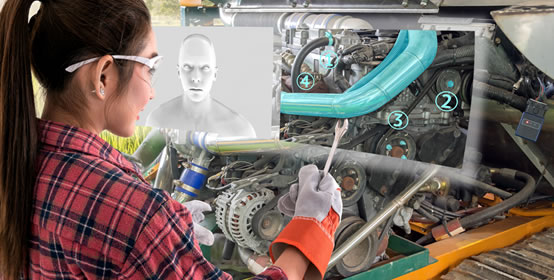
Augmented reality works by projecting digital text, images, or 3D models onto the real world through devices like smartphones, tablets, smart glasses, or headsets. Instead of checking a paper manual or stopping to look at a computer, workers can see instructions, diagrams, or even animations placed directly on the equipment they are using.
The concept may have entered mainstream culture through games like Pokémon Go, but its true value is now showing in factories. AR can guide a worker through a complicated assembly, highlight mistakes in real time, or display live data from a machine. This ability to merge information with physical work is why AR is spreading so quickly in manufacturing.
AR is reshaping how products are built. By projecting virtual models onto real components, workers can compare what they are building with the correct version and catch mistakes immediately. This not only improves quality but also speeds up production.
Airbus began experimenting with AR more than a decade ago to overlay assembly designs onto aircraft parts, helping workers detect errors. Today, companies like Volkswagen, Boeing, and Ford are using AR to streamline complex assembly lines. Workers can now follow digital step-by-step instructions, reducing the risk of errors and cutting down on rework.
AR also enables collaboration across global teams. Engineers can share what they see with colleagues in other locations, allowing experts to solve problems in real time. With supply chains under pressure, this ability to troubleshoot quickly has become a valuable advantage.
Another strength is safety. AR can provide instant alerts about hazards, highlight incorrect tool usage, or warn workers when machines are overheating. By linking AR systems to IoT sensors, factories are creating smarter production floors that protect both employees and equipment.
Training new workers has always been a challenge in manufacturing. Traditional methods are time-consuming, costly, and sometimes risky when inexperienced workers handle complex equipment. AR is solving this by creating immersive, hands-on tutorials that reduce the learning curve.
With AR, trainees can use smart glasses or tablets to see instructions projected directly onto a machine. Instead of relying on paper manuals, they follow holographic arrows, notes, or animations that guide them step by step.
Companies in aerospace and automotive have reported strong improvements in accuracy and efficiency by using AR-guided training. Lockheed Martin, for example, has tested AR to support aerospace assembly work, while Bosch has built AR-powered training programs for technicians. Though results vary by company, the trend is clear: AR is making it faster and safer to train workers at scale.
By 2025, AR training has spread beyond large corporations to smaller and mid-sized manufacturers thanks to more affordable devices and user-friendly software. For younger employees, who are already familiar with digital tools, AR is both intuitive and engaging. It helps new hires build confidence while improving knowledge retention.
Maintenance is one of the most expensive and time-sensitive aspects of manufacturing. A single machine breakdown can cost thousands of dollars per hour in lost productivity. AR is making maintenance faster, more accurate, and less dependent on specialized staff.
Instead of flipping through binders or waiting for expert support, technicians can scan a QR code or IoT tag on the machine. Immediately, a digital overlay shows the service history, live performance data, and step-by-step repair instructions.
Some AR platforms even animate the exact parts that need attention, such as bolts, circuits, or valves. With smart glasses, workers can follow these instructions hands-free, keeping their focus on the repair.
Linking AR with IoT sensors also enables predictive maintenance. If a motor overheats or a valve shows abnormal pressure, the system can alert a technician and provide a repair guide before a breakdown occurs. Remote collaboration is another major benefit: with AR headsets, a local worker can share their view with an expert anywhere in the world, who can walk them through the fix in real time.
In highly regulated industries like aerospace, automotive, and pharmaceuticals, safety and compliance are critical. AR is helping companies meet these demands more consistently.
Workers can use AR to follow safety protocols step by step, from confirming protective gear to completing inspection checklists. Restricted zones or dangerous conditions can be highlighted visually, making risks clearer.
AR systems can also log inspection activity, providing proof for auditors that procedures were followed correctly. This reduces the risk of costly mistakes while building a culture of safety.
AR is also transforming product and factory design. Through digital twins, which are virtual replicas of machines or entire facilities, manufacturers can test and optimize layouts before making physical changes.
BMW, for example, uses Nvidia’s Omniverse platform to simulate and refine its factory environments. Teams can collaborate on the same digital model in real time, even when located in different countries.
AR supports prototyping as well. Engineers can visualize how a new part will fit within a system or how a design will function in practice without building a physical model. This reduces waste, saves money, and accelerates innovation.
Beyond efficiency, AR is improving the worker experience. Manufacturing can be stressful, especially when tasks are complex or mistakes are costly. AR reduces this stress by breaking down work into clear, visual steps that employees can follow confidently.
For younger generations entering the workforce, AR offers a more familiar and engaging environment. Instead of flipping through thick manuals, they receive real-time digital guidance. This makes manufacturing jobs more attractive, helps workers learn faster, and supports employee retention.
One of the main barriers to AR adoption used to be cost. Early devices were bulky, expensive, and difficult to integrate into daily operations. By 2025, this has changed. Manufacturers can now deploy AR through a wide range of devices, from advanced headsets to simple tablets and smartphones.
Headset shipments are projected to increase by more than 40 percent in 2025, driven by new hardware and falling prices. At the consumer level, devices like Meta’s Ray-Ban smart glasses are proving that AR wearables can be both practical and widely adopted.
For manufacturers, this means AR is no longer a pilot project or niche investment. It is a scalable solution that can be rolled out across entire factories without massive upfront costs.
The global AR market is projected to surpass $149 billion in 2025. Within manufacturing, AR is expected to grow rapidly, with forecasts showing the segment reaching $26 billion in 2025 and expanding to more than $130 billion by 2034.
Looking forward, AR will merge more deeply with artificial intelligence, robotics, and IoT. Factories will not only display live data through AR devices but also use AI to analyze that data and recommend actions. This will shift AR from a supportive tool to an integrated system that optimizes entire production processes in real time.
For manufacturers, this means fewer errors, less downtime, and higher efficiency. For workers, it means safer jobs, faster training, and a more engaging work environment.
In 2015, only a fraction of manufacturers were experimenting with AR. A decade later, it has become a core technology that drives production, training, maintenance, and safety. The combination of better hardware, lower costs, and measurable business benefits has made AR one of the most important tools in modern industry.
The message is clear: AR is no longer just a trend. It is a turning point. Companies that adopt it today are not just keeping up with change, they are shaping the future of manufacturing itself.